

The Eye Clinic3 min read
This page goes with our booklet, Macular Degeneration: What You Need to Know, about age-related macular degeneration (AMD). Below is a short summary of the booklet, the published research it draws on, and where to read more.
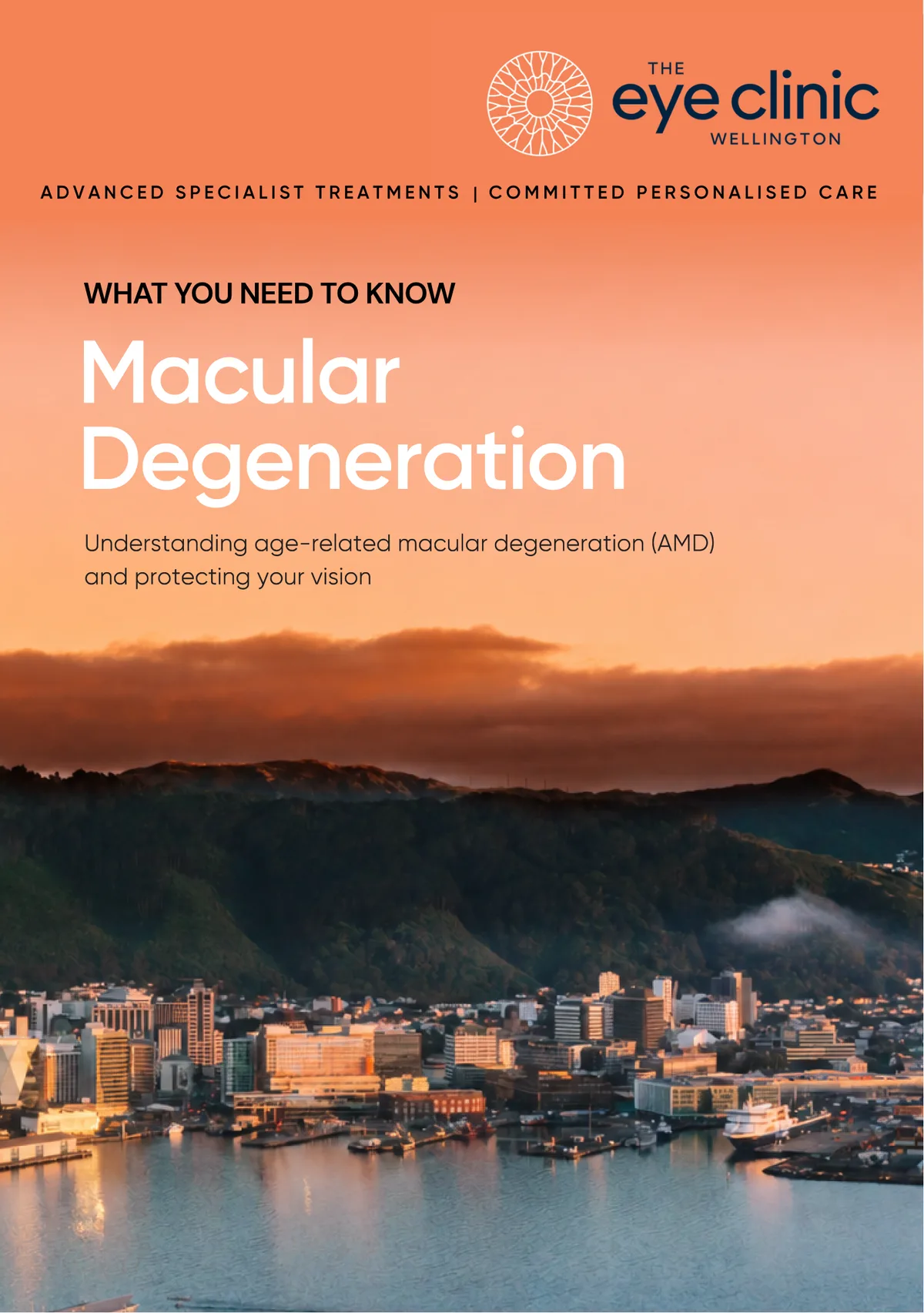
Macular Degeneration: What You Need to Know
Read the full booklet online, turning the pages just like the printed copy, or download it to print.
What is AMD?
AMD affects the macula, the centre of the retina that gives us sharp, detailed vision for reading, faces and driving. It mainly affects central vision; side vision is usually preserved. It develops through a mix of ageing, genetics and lifestyle, and is a disease, not a normal part of ageing.
Dry AMD, geographic atrophy and wet AMD
In dry AMD, deposits called drusen build up beneath the retina and vision can slowly deteriorate. Geographic atrophy is an advanced form of dry AMD, where patches of retinal cells are permanently lost. In wet AMD, abnormal blood vessels leak fluid or blood, which can change vision quickly and needs prompt treatment.
What you can do
Have regular eye examinations, eat well, stay active and don't smoke. For people with intermediate AMD, or advanced AMD in one eye, a supplement based on the Age-Related Eye Disease Study 2 (AREDS2) may reduce the risk of progression [1]. It doesn't reverse damage, so ask us whether it suits you.
Treatment
Dry AMD: newer options offered at the clinic include photobiomodulation (PBM) [2, 3, 10, 11], subthreshold laser [4, 5] and microcurrent therapy [6]. They can't cure AMD, but may help suitable patients.
Wet AMD: anti-vascular endothelial growth factor (anti-VEGF) injections reduce leakage and can often stabilise vision [7]. Treatment is usually ongoing, with optical coherence tomography (OCT) scans guiding the timing.
Know what to watch for
Check each eye regularly with the Amsler grid in your booklet. If you notice a sudden change in central vision, new distortion, a dark or blank patch, or a rapid drop in vision, call us on 04 470 7663.
References & further reading
AMD & AREDS2
- 1
Age-Related Eye Disease Study 2 Research Group. Lutein + zeaxanthin and omega-3 fatty acids for age-related macular degeneration: the AREDS2 randomized clinical trial. JAMA. 2013;309(19):2005–2015.
Read the article
Photobiomodulation therapy
- 2
Borrelli E, Coco G, Pellegrini M, et al. Safety, tolerability, and short-term efficacy of low-level light therapy for dry age-related macular degeneration. Ophthalmol Ther. 2024;13(11):2855–2868.
Read the article - 3
Jaffe GJ, Boyer D, Hu A, et al. Long-term efficacy and safety of photobiomodulation in dry AMD: LIGHTSITE III 24-month analysis. Retina. 2026;46(5):783–795.
Read the article
Subthreshold laser
- 4
Luttrull JK, Sinclair SH, Elmann S, Chang DB, Kent D. Slowed progression of age-related geographic atrophy following subthreshold laser. Clin Ophthalmol. 2020;14:2983–2993.
Read the article - 5
Huang Z, Deng KY, Deng YM, Hui YN, Song YP. Long-term outcomes of drusenoid pigment epithelium detachment in intermediate AMD treated with 577 nm subthreshold micropulse laser. Int J Ophthalmol. 2022;15(3):474–482.
Read the article
Microcurrent therapy
- 6
Parkinson KM, Sayre EC, Tobe SW. Evaluation of visual acuity in dry AMD patients after microcurrent electrical stimulation. Int J Retina Vitreous. 2023;9(1):36.
Read the article
Wet AMD & anti-VEGF therapy
- 7
Comparison of Age-related Macular Degeneration Treatments Trials (CATT) Research Group. Ranibizumab and bevacizumab for treatment of neovascular age-related macular degeneration: two-year results. Ophthalmology. 2012;119(7):1388–1398.
Read the article
Further reading
- 8
National Eye Institute. Age-Related Macular Degeneration (AMD). National Institutes of Health.
Read the article - 9
Peeples L. Does red-light therapy work? Here's what the science says. Scientific American. 26 Mar 2026.
An accessible overview of photobiomodulation, including its effects on mitochondria, emerging clinical applications and the current limits of the evidence.
Read the article - 10
Leong J. Real-world effects of PBM for dry AMD. NZ Optics. 6 Apr 2026.
Clinical review and early NZ real-world experience with PBM.
Read the article - 11
Wu AY, Leong J, Kang H. Photobiomodulation for age-related macular degeneration: real-world outcomes from an Australasian-first retrospective case series. RANZCO 2026 Congress Abstracts, Abstract 67.
Conference abstract from the Royal Australian and New Zealand College of Ophthalmologists (RANZCO) 2026 Congress, not yet published in full. Shared here by the authors.
Read the abstractHide the abstract
Purpose: To evaluate the efficacy and safety of photobiomodulation (PBM) using the EyeLight device for age-related macular degeneration (AMD). As the first retrospective Australasian case series, this study compares local real-world outcomes with published international data and explores future clinical applications.
Method: A retrospective case series was conducted in patients with AMD treated using a standardized EyeLight PBM protocol. Treatment employed 590 nm (yellow) and 630 nm (red) light to target cellular metabolism. Outcomes included best-corrected visual acuity (BCVA) and anatomical changes assessed with optical coherence tomography (OCT) and fundus autofluorescence.
Results: Fifty eyes from 25 patients were analysed. Thirteen patients completed one treatment block and 12 completed two blocks. Reflecting routine clinical practice, the cohort included eyes often excluded from clinical trials, including 19 eyes (38%) with foveal-involving atrophy and 5 eyes (10%) with active exudative AMD. After one treatment block, 30 eyes (60%) gained at least one line of BCVA, while 17 eyes (34%) gained two or more lines. OCT demonstrated a modest reduction in drusen volume. No ocular or systemic adverse events occurred, and no new cases of exudative AMD developed. Outcomes are compared with international studies and alternative FDA-approved PBM devices, including the Valeda Light Delivery System.
Conclusion: This first Australasian real-world case series suggests that EyeLight PBM is a safe and effective treatment for AMD. Improvements in visual acuity and anatomical stability were consistent with international literature, supporting the potential role of PBM in routine AMD management.
Support in New Zealand
Macular Degeneration New Zealand: AMD information, education and patient support. 0800 622 852.
Visit websiteBlind Low Vision NZ: low-vision aids, adaptive technology and practical support. 0800 24 33 33.
Visit websiteRetina New Zealand: peer support and information for people with retinal conditions, including macular degeneration. 0800 569 849.
Visit website
References current at September 2026.